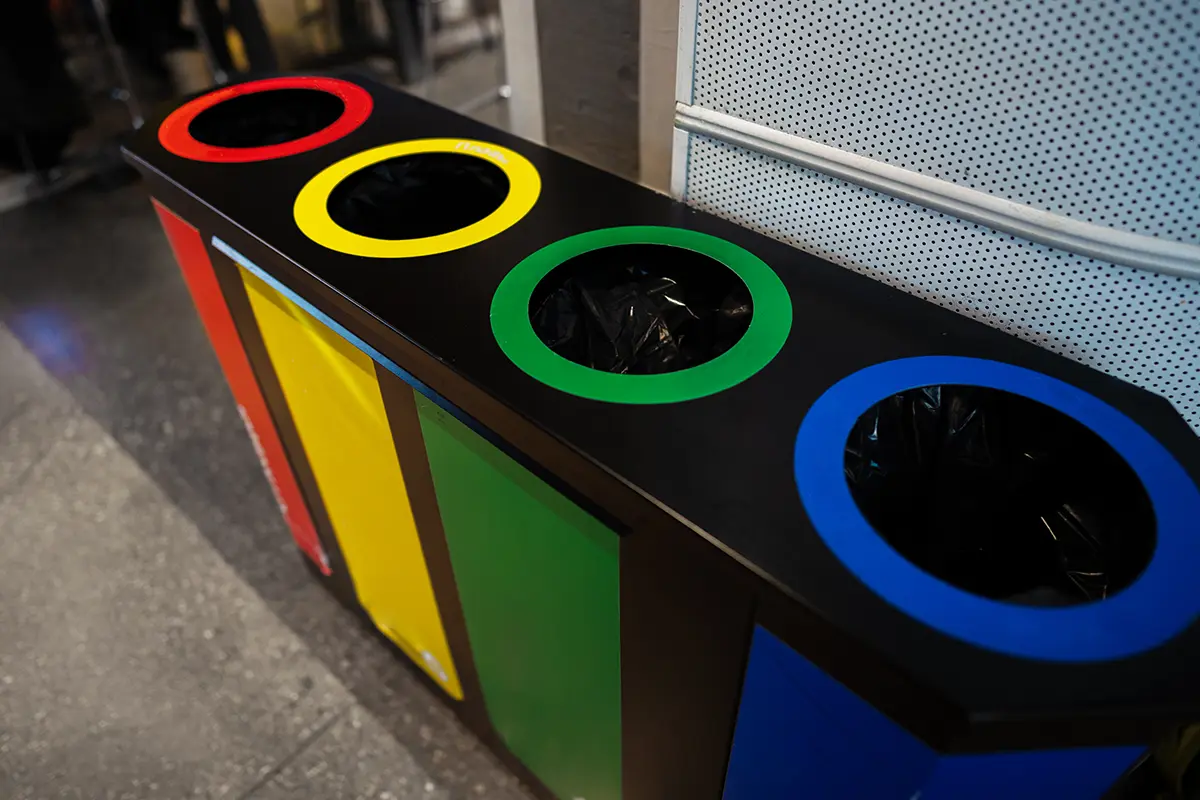
Behavioral architecture is the intentional design of environments to influence human decision-making. In the context of waste management, it means building systems that make the sustainable choice the easiest and most obvious default. By understanding how occupants actually interact with bins and signage, facilities can deploy technology that guides users toward correct disposal habits without relying on constant supervision or posters that people stopped noticing years ago.
Reducing recycling contamination with behavioral architecture
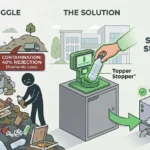
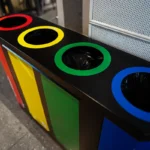
Recycling contamination is one of the primary obstacles to achieving zero-waste goals. It occurs when non-recyclable materials enter the recycling stream, leading to rejected loads, extra labor, higher hauling fees, and lost commodity value. In many programs, contamination rates are reported in the 20–30% range by weight, high enough that entire loads are often landfilled instead of recovered. Most facilities try to solve this with more posters, but static signage frequently fails because of visual fatigue and sensory adaptation: people simply tune it out over time.
Behavioral or “choice” architecture addresses this by engineering the moment of disposal instead of relying on memory and good intentions. Rather than a passive bin that silently accepts anything, a smart system becomes an active participant in the process. By designing the environment to provide immediate feedback and a clear, simple path to “doing the right thing,” facilities can move from a culture of “hopeful recycling” to one of engineered compliance.
The Topper Stopper™ as a quality gate
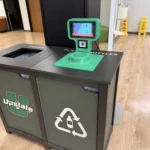
The Topper Stopper™ technology is an example of behavioral architecture in action. It functions as a physical intervention that helps reduce human error at the recycling bin, the same kind of error that devalues the recycling industry and undermines ESG reporting. Instead of treating recycling as “managing waste,” the system reframes it as manufacturing a clean, high-quality raw material stream.
In practice, the Topper Stopper™ acts like a quality gate in a production line. Before material enters the “process,” your recycling stream, it passes through a device that checks whether it belongs there. Other smart-bin deployments that combine item recognition and feedback have reported meaningful reductions in contamination and improvements in participation. The core principle is the same: move quality control to the source at the moment of disposal instead of relying on downstream checks at the loading dock or processing facility.
Strategic design friction used well
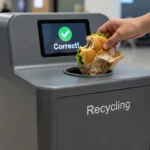
In most user-experience conversations, “friction” is treated as something to eliminate. Strategic design friction, used sparingly and intentionally, is different and can be a powerful way to prevent costly errors. The Topper Stopper™ uses a controlled opening that stays closed until an item is scanned and confirmed. This split-second pause interrupts the user’s autopilot mode and nudges them from fast, instinctive behavior into a more intentional decision.
That tiny bit of friction functions as a quality gate. Just as a manufacturing plant uses gates and checks to prevent defective parts from moving down the line, this technology helps prevent contaminants from entering the recycling stream. The friction is minimal, typically lasting only a second or two, but the value of what it protects, a clean, marketable stream with fewer rejections and penalties, is immense.
Real-time feedback and micro-learning
Behavioral change is most effective when the feedback loop is immediate and contextual. When a user scans an item at a Topper Stopper™ station, they receive instant confirmation. An “Accepted” message provides positive reinforcement, while a gentle rejection message corrects the behavior on the spot. Over repeated interactions, this becomes a powerful training tool.
This process facilitates micro-learning. Instead of asking occupants to memorize a complex and changing list of what is and is not recyclable in that building, the system teaches them in small, frequent moments. Over time, users build an intuitive sense of what gets accepted, and point-of-disposal feedback in similar settings has been linked to measurable reductions in contamination and improved sorting accuracy. The cognitive load on the user drops, and the system becomes a helpful guide rather than a barrier.
The financial reality: friction versus contamination
When evaluating new technology, facility managers must weigh the cost of a small user pause against the massive costs of a failed recycling program. A few extra seconds at the bin may feel like a cost, but it is tiny compared to the operational and financial impact of contaminated waste streams.
The high cost of contamination
Contamination is not just an environmental issue. It is also a significant financial liability. Rejected loads come with higher hauling and tipping fees, additional processing charges, and lost value in materials that could otherwise have been sold as commodities. In documented cases, focused contamination-reduction efforts have nearly halved contamination rates while increasing overall recycling tonnage. This illustrates how much money and material quality is lost when contamination is not addressed.
There is also a substantial labor cost. Janitorial teams may spend hours re-sorting bins, cleaning up after “wish-cycled” coffee cups that leak over bags of plastic and aluminum beverage containers, or explaining to occupants why their building is suddenly off track for sustainability targets. When a program is consistently contaminated, it loses credibility with both staff and occupants. Participation drops, reporting becomes less reliable, and achieving diversion, zero-waste, or ESG commitments becomes increasingly difficult.
The ROI of strategic friction
The cost of strategic friction is measured in seconds of user time and a modest investment in smart infrastructure. When the technology is fast and the interface is intuitive, this cost is negligible in the context of an occupant’s day. In contrast, the potential return on investment for preventing contamination at the source is substantial: fewer rejected loads, less manual re-sorting, more consistent diversion performance, and higher commodity value for cleaner recyclables.
By ensuring a cleaner stream at the point of disposal, facilities protect the value of their material and reduce the risk of vendor fines or contract penalties. In other sectors, smart waste and recycling systems that combine better data, feedback, and automation have reported double-digit reductions in contamination and measurable decreases in collection and processing costs. Investing in behavioral architecture is not just buying a bin. It is buying an insurance policy for the integrity of your sustainability program and the credibility of your ESG story.
Enhancing the environment with digital signage
Digital signage is the final piece of the behavioral architecture puzzle. Unlike static stickers, digital screens remain visually active and can adapt to the specific needs of a facility in real time. They help solve the sensory adaptation problem, our tendency to ignore things that never change, by keeping content dynamic and context-aware.
Dynamic messaging and social proof
Screens allow for dynamic messaging that can change based on the time of day, the service being offered, or even the products being sold in a nearby café. When iced drinks are popular in the afternoon, the screen can spotlight how to properly dispose of cups, lids, and straws. When there is a building-wide sustainability push, screens can highlight that message while reinforcing correct disposal behavior.
Digital signage can also be used to display social proof, such as diversion leaderboards or real-time impact metrics. Seeing that “Floor 4 has reached 95% accuracy this week” creates a visible social norm and a friendly sense of competition. Behavioral campaigns that use norms, recognition, and personalized feedback have repeatedly shown they can nudge people toward better recycling behavior. Screens at the bin are a natural place to bring that playbook to life.
Overcoming sensory adaptation
Humans are wired to filter out constant, unchanging stimuli. That is why recycling posters that worked on day one are nearly invisible by month six. Digital signage addresses this by using motion, color, and updated content to catch the eye at the exact moment a disposal decision is being made. When combined with interactive elements such as scan results, “thank you” messages, or real-time accuracy stats, the screen becomes part of the feedback loop instead of just digital wallpaper.
Conclusion: Engineering a sustainable future
The shift from traditional bins to smart, behavior-driven recycling stations is a necessary step for organizations that are serious about zero-waste and credible ESG performance. By leveraging behavioral architecture, strategic design friction, and real-time feedback, technologies like the Topper Stopper™ turn a mundane task, throwing something away, into a precise, data-informed operation.
This approach begins with a realistic assumption: people are busy, distracted, and often operating on autopilot. Rather than demanding that everyone become an expert recycler, we reshape the environment so that the right choice is guided, validated, and reinforced. By trading a tiny amount of effort at the bin for a large improvement in material quality, data integrity, and program credibility, we can finally make recycling work as intended at scale and for the long term.