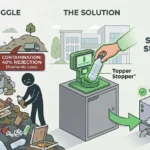
Recycling contamination is the silent budget killer in commercial waste programs. When a stream is compromised, recycling often turns into landfill disposal plus extra handling, rejected loads, vendor disputes, and reputational risk. This occurs without delivering measurable sustainability outcomes.
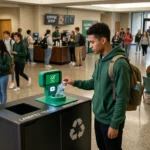
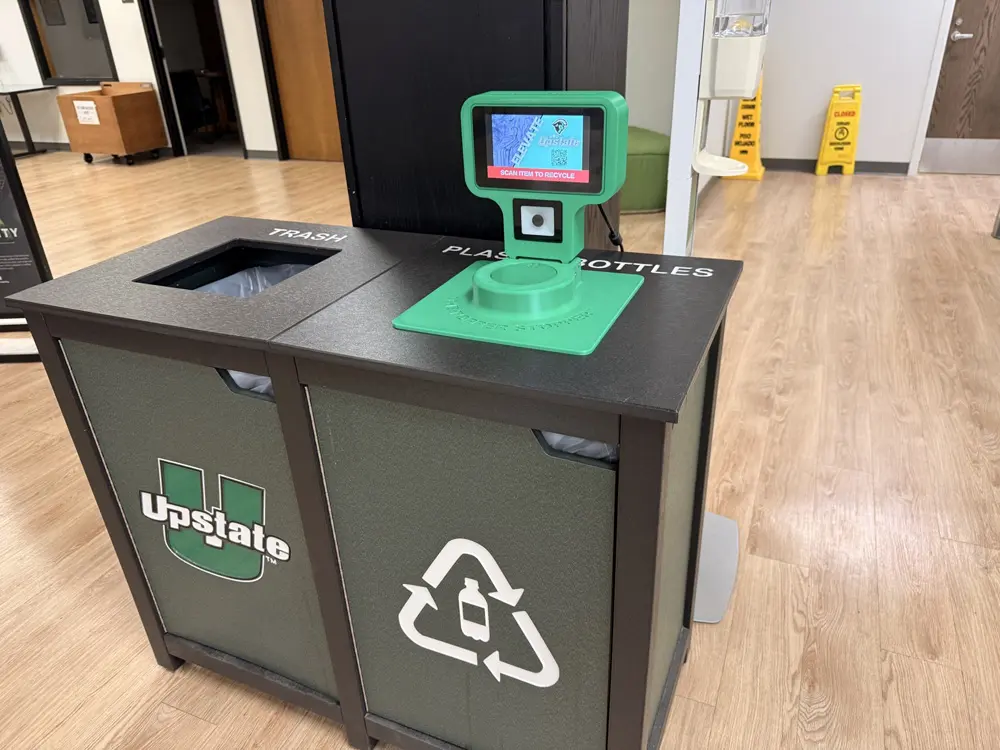
A recent real-world pilot at USC Upstate tested a different approach. The strategy utilized behavior-guiding physical design that restricts the recycling stream to PET #1 bottles and aluminum cans. Over 46 days, 5 Topper Stopper™ units captured 602 containers, including 497 PET bottles and 105 aluminum cans. The results showed 0% observed contamination in high-traffic, unmonitored conditions with no mandatory training and no enforcement. The stream was physically audited multiple times to verify purity, and environmental impact potential was modeled using EPA WARM.
For a CFO, the strategic shift is clear. Contamination control becomes operationally predictable and therefore financeable.
Key Takeaways for the CFO
Contamination prevention is the core economic lever rather than commodity value. A 0% contamination rate becomes credible when paired with audits, definitions, and logs. The pilot produced a scalable baseline of 2.617 items per unit per day. Finally, a 90-day pilot should be structured to produce a bankable rollout decision instead of a feel-good trial.
1) Why Recycling Contamination is an ROI Problem
Most organizations try to reduce recycling contamination with education campaigns such as signage, reminders, and training. However, high-traffic facilities like campuses, airports, stadiums, hospitals, and corporate campuses are not controlled environments. People move fast, dispose impulsively, and engage in wish-cycling.
Financially, contamination creates several issues. These include rejected loads or contamination penalties where applicable. It also leads to higher landfill tonnage when recycling is trashed post-collection. Furthermore, it causes more labor variance through extra sorting, re-bagging, and escalations. Finally, it results in unreliable reporting that makes it difficult to defend ESG claims without purity.
Systems that make correct behavior the default can reduce reliance on recurring training spend and constant enforcement.
2) What 0% Contamination Means and How to Bound Performance Risk
In the USC Upstate pilot, 0 non-target items were observed across 602 deposited items. That is a strong operational signal, but CFOs should still ask about the uncertainty. A practical upper-bound estimate often used when zero failures are observed is the rule of three.
With 602 items, the calculation is as follows:pupper≈6023≈0.50%
Based on this sample, the true contamination rate is plausibly below 0.50% at high confidence. This assumes audits were executed consistently and conditions were representative. This is a finance-friendly way to translate zero contamination into bounded operational risk.
3) The CFO-Grade Metrics to Require in a 90-Day Recycling Pilot
If the goal is to justify a scaled deployment of 10, 25, or 50 units, you need metrics that survive procurement review and internal audit.
1. Contamination Rate and Purity
Define contamination up front by deciding if it includes any non-target item, liquids, or bagged trash. Track non-target items observed per audit interval and per unit. Require timestamped audit logs and optional photos.
2. Throughput and Capture Volume
Track items per unit per day by location. The USC Upstate pilot baseline was calculated as follows:
Items per Unit-Day=5×46602=2.617
3. Service Economics
Monitor emptying frequency, average minutes per service, and variance by location. If labor impact is not measured, ROI claims are merely guesswork.
4. Downtime and Exceptions
Log repairs, relocations, outages, and damaged components. This prevents inflated performance claims and clarifies the operational burden.
5. Impact Methodology Clarity
Distinguish between measured data and modeled data. Measured data includes counts, audits, downtime, and service events. Modeled data includes CO2, water, energy, and any material value estimates. If using EPA WARM, document all factors and assumptions.
4) Scaling Model for a Budget Spreadsheet
Once you have a baseline throughput rate, scaling can be forecast transparently using the following formula:Projected Items=U×D×r×m
In this equation, U represents units deployed and D represents days. The variable r is the baseline items per unit-day, which was 2.617 in the pilot. The variable m is the site multiplier, which serves as a scenario parameter based on traffic consistency. Use a conservative low, base, and high sensitivity table rather than a single-point estimate. Multipliers should be validated by your own pilot because facility patterns differ regarding vending density, foot traffic, operating hours, and concession volume.
5) Building the ROI Case
The pilot reported modeled impact potential and a modest recovered material value. Those are useful, but CFO-grade ROI usually hinges on three operational buckets.
A. Avoided Contamination Costs
This is the primary lever. It includes fewer rejected or contaminated loads and less landfill diversion backslide. It also includes reduced troubleshooting time for complaints, escalations, and re-sorting. This is often the hidden cost center that must be quantified.
B. Labor and Service Predictability
Cleaner streams typically reduce exceptions and stabilize service cadence. Location intelligence, such as knowing which placements drive volume, reduces wasted servicing.
C. Commodity and Rebate Value
Treat commodity value as upside rather than the primary justification. Markets fluctuate, but contamination reduction is a controllable input.
6) Structuring a 90-Day Pilot for an Investment Decision
A pilot should answer one finance question. If we scale to 50 units, what performance and operating costs should we expect under conservative assumptions?
Specify the following up front:
- Placement hypotheses including vending-adjacent areas, choke points, exits, and concessions.
- Audit cadence and ownership.
- Success thresholds such as a contamination upper bound, minimum throughput, and maximum downtime.
- Rollout triggers that define what results justify expansion to 25, 50, or 100 units.
This turns the act of trying a recycling program into a controlled test that produces decision-grade evidence.
Conclusion: Contamination Control Makes Recycling Financeable
Recycling contamination is typically treated as a people problem. The USC Upstate results suggest it can be treated as a design and measurement problem. This approach produces clean streams, actionable data, and bounded risk.
For CFOs overseeing waste management costs and sustainability outcomes, the question becomes practical. What does 90 days of audit-verified, low-contamination performance deliver in our facility, and how quickly can it scale?