For the past two years, we have discussed the potential of our Material Authentication Units. We have shared the designs, the vision, and the goal of achieving zero contamination in high-traffic recycling environments. We have explained why physical design beats education campaigns and why limiting material types creates behavioral clarity.
But in the world of facilities management and sustainability operations, potential does not pay the bills. Performance does.
That is why we took our Material Authentication Units out of the lab and into the wild.
The Reality Check: A Live Deployment in High-Traffic Conditions
From November 7 through December 31, 2025, we deployed 5 Material Authentication Units across the USC Upstate campus in a strategic soft-launch pilot. This was not a controlled demo with hand-picked participants. This was a live, unmonitored deployment in real-world conditions:
- High-traffic zones including the Gymnasium, Health Education Center, and main campus thoroughfares
- No mandatory training sessions or awareness campaigns
- No staff supervision or behavioral enforcement
- Real students with real habits, distractions, and time pressures
We installed the units on existing recycling bins, restricted the stream to two target materials, which were PET number 1 plastic bottles and aluminum cans, and let the infrastructure guide behavior through physical design constraints.
Then we measured everything.
The Receipts: What 46 Days of Real-World Use Actually Proved
The results of this soft launch have officially moved the Material Authentication Unit from conceptual innovation to proven operational technology:
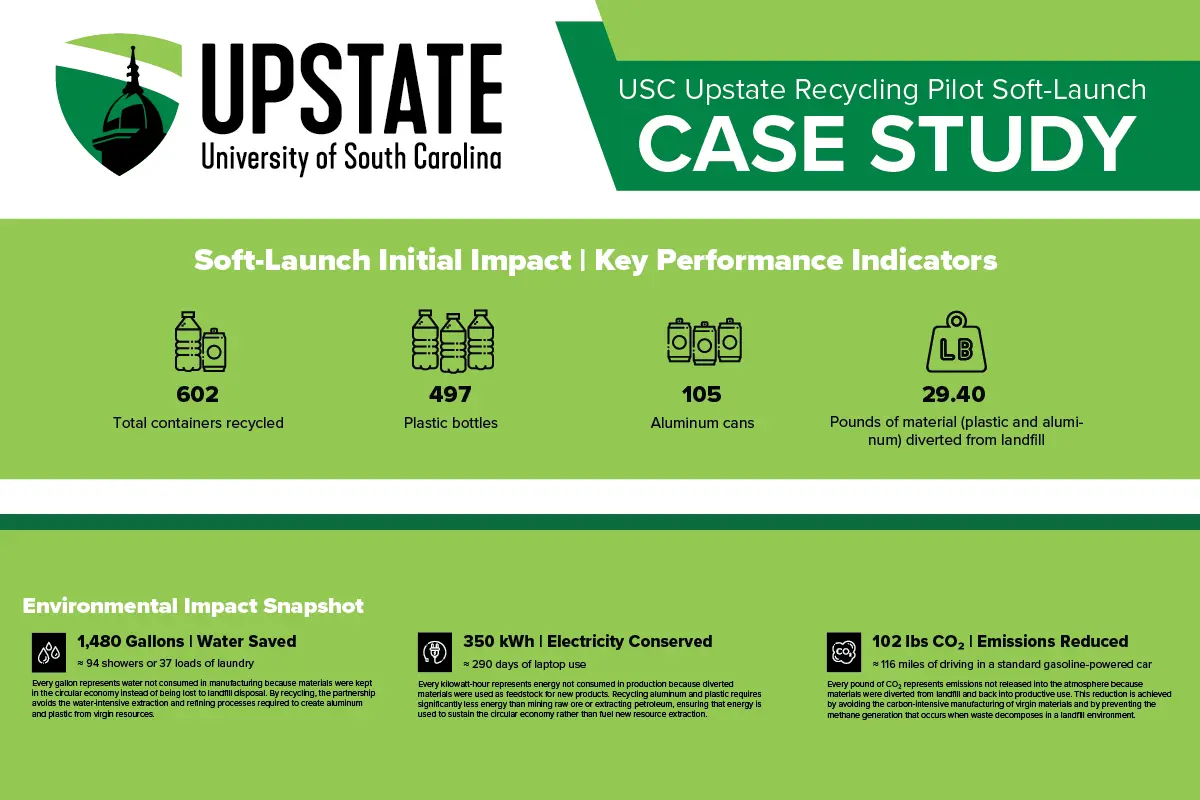
602 Containers Captured
This was not a small sample size or a one-week novelty test. Over 46 consecutive days, the system captured 497 plastic bottles and 105 aluminum cans, averaging 13.1 items per day across all five units.
0% Contamination Rate
This is the metric that matters most. In 46 days of unmonitored, high-traffic use, not a single piece of trash entered the recycling stream. No coffee cups, no food wrappers, and no wishful recycling were found. Our physical design forced correct sorting behavior 100% of the time.
Calculated Environmental Impact Potential
We did not rely on guesswork. The recycling bins were physically audited multiple times throughout the 46-day pilot to verify the purity of the stream. Using these verified counts, we applied EPA WARM (Waste Reduction Model) standards to calculate the potential environmental impact:
- 29.4 lbs of material diverted from landfill
- 1,480 gallons of water savings potential, equivalent to 94 showers
- 350 kWh of electricity conservation potential, or 290 days of laptop use
- 102 lbs of CO2 reduction potential, which avoids 116 miles of driving
- $26.32 in recovered material value
Location Intelligence That Drives Decisions
The data revealed clear performance patterns. The Gymnasium captured 43.6% of all items, validating our hypothesis that high-activity zones near vending machines and athletic facilities are prime placement locations. This kind of actionable intelligence allows facility managers to optimize both placement strategy and servicing schedules.
Why This Matters for Hesitant Adopters
If you have been interested in our verification technology but waiting for real-world proof before de-risking your facility’s recycling program, the wait is over.
This pilot proved three things that every facility manager, sustainability officer, and CFO needs to know:
- The Infrastructure is Robust: It survived 46 days in a college gymnasium, one of the ultimate high-traffic stress tests. Unit issues were minimal and quickly resolved. There were no system breakdowns and no contamination. The system works without constant oversight.
- The Data is Actionable: We now know exactly which locations drive volume, which days see peak activity, and how placement affects performance. This is operational intelligence that informs labor allocation, bin servicing, and expansion planning.
- The ROI is Scalable: Because the bins were physically audited and impact metrics were calculated using EPA WARM standards, we can now project the potential environmental impact of a 10, 25, or 50 unit deployment in your specific environment.
From Pilot Data to Your Facility: The Scaling Model
The 5 unit soft launch gave us more than proof. It gave us a predictive model. Because we now know the Material Authentication Unit captures an average of 2.617 items per unit per day with 0% contamination, we can project exactly what a larger deployment will deliver.
What a 90-Day Deployment Looks Like (Campus Baseline)
| Units Deployed | Containers Captured | Water Savings Potential | Energy Conservation Potential | CO2 Reduction Potential | Material Value |
| 10 | ~2,356 | ~5,790 gal | ~1,370 kWh | ~399 lbs | ~$103 |
| 25 | ~5,890 | ~14,470 gal | ~3,430 kWh | ~998 lbs | ~$257 |
| 50 | ~11,780 | ~28,940 gal | ~6,860 kWh | ~1,996 lbs | ~$515 |
Projections are based on 2.617 items per unit-day observed during the soft launch. Environmental impact potential is calculated using EPA WARM standards, assuming 0% contamination and campus-level traffic patterns.
The Campus Variable: Why Your Facility May Outperform These Projections
Here is what makes these numbers even more compelling: they represent a conservative baseline. The USC Upstate pilot took place during an academic period that included a 4-day Thanksgiving break campus closure, final exam preparation with reduced social traffic, weekend periods with minimal campus activity, and variable class schedules.
Despite these heavy traffic fluctuations, the Material Authentication Units maintained 0% contamination and consistent performance.
What This Means for Facilities with Consistent, High-Frequency Traffic
Venues like airports, transit stations, stadiums, shopping malls, and hospitals operate with highly predictable daily patterns, higher baseline traffic density, extended operational hours, and beverage-driven disposal behavior. Based on traffic density analysis and operational patterns, facilities with consistent foot traffic can expect performance to exceed the campus baseline by 20 to 60 percent.
Conservative Performance Multipliers by Venue Type
| Venue Type | Traffic Consistency | Expected Multiplier | Rationale |
| College Campus | Variable | 1.0x | Pilot baseline |
| Corporate Campus | Moderate | 1.2x to 1.3x | Consistent weekday traffic, predictable break patterns |
| Shopping Mall | High | 1.3x to 1.5x | Retail hours create reliable traffic, food courts drive consumption |
| Transit Hub | Very High | 1.4x to 1.6x | Commuter patterns repeat daily, high on-the-go beverage use |
| Airport | Very High | 1.5x to 1.7x | Security checkpoints create disposal bottlenecks, pre-boarding discard behavior |
| Stadium/Arena | Event-Driven | 1.6x to 2.0x | Massive event surges, high concession sales, captive audience |
| Hospital | Continuous | 1.3x to 1.5x | 24/7 operations, cafeteria traffic, consistent visitor and staff flow |
Adjusted 90-Day Projections for High-Traffic Venues
Airport Deployment (1.6x multiplier)
| Units Deployed | Containers Captured | Water Savings Potential | Energy Conservation Potential | CO2 Reduction Potential |
| 10 | ~3,770 | ~9,260 gal | ~2,190 kWh | ~638 lbs |
| 25 | ~9,424 | ~23,150 gal | ~5,470 kWh | ~1,597 lbs |
| 50 | ~18,848 | ~46,300 gal | ~10,940 kWh | ~3,194 lbs |
Transit Hub Deployment (1.5x multiplier)
| Units Deployed | Containers Captured | Water Savings Potential | Energy Conservation Potential | CO2 Reduction Potential |
| 10 | ~3,534 | ~8,685 gal | ~2,055 kWh | ~599 lbs |
| 25 | ~8,835 | ~21,705 gal | ~5,138 kWh | ~1,497 lbs |
| 50 | ~17,670 | ~43,410 gal | ~10,275 kWh | ~2,994 lbs |
Stadium/Arena Deployment (1.8x multiplier)
| Units Deployed | Containers Captured | Water Savings Potential | Energy Conservation Potential | CO2 Reduction Potential |
| 10 | ~4,242 | ~10,422 gal | ~2,466 kWh | ~719 lbs |
| 25 | ~10,602 | ~26,046 gal | ~6,163 kWh | ~1,796 lbs |
| 50 | ~21,204 | ~52,092 gal | ~12,326 kWh | ~3,593 lbs |
Multipliers are conservative estimates based on traffic density, operational hours, and beverage consumption patterns observed in comparable venue types. Environmental impact potential is calculated using EPA WARM standards.
What the Zero-Contamination Result Actually Validates
Achieving 0% contamination in a real-world pilot is not just a performance metric. It is proof of concept validation across multiple dimensions:
- Design Validation: The two-material restriction combined with the physical constraints of the automated access door successfully prevented incorrect disposal behavior without requiring upstream user education.
- Behavioral Science Validation: When the right action is also the easiest action, compliance becomes automatic. The technology guided behavior through physical design friction and structural clarity, not rules enforcement.
- Operational Validation: The system required no constant on-site supervision, no physical monitoring, and no manual corrective interventions. It functioned as designed from day one through day 46.
- Data Methodology Validation: Physical audits verified collection counts and material stream purity. EPA WARM-based calculations provide the potential environmental impact based on industry-standard lifecycle assessments. Decision-makers can trust the projections because the methodology is transparent and replicable.
From Interesting Idea to Deployable System
Our material validation platform is no longer just a concept. It is a functioning, data-generating technology that solves the contamination crisis in high-traffic environments. We have established real-world performance data, audit-verified impact metrics, predictive scaling models, location heat-mapping for optimization, and operational proof that zero supervision is required.
For facility managers, sustainability officers, and CFOs who have been waiting for proof before de-risking adoption, the data is here.
The question is no longer whether the system works. The question is what will 90 days of clean data look like in your facility?
Ready to Move from Concept to Certainty?
We are now offering structured 90-day pilot deployments using 10 or more Material Authentication Units designed to validate performance, prevent contamination, and generate decision-grade data for your specific environment.
Request Your 90-Day Impact Projection →
Or download the full USC Upstate case study to see the complete methodology, data verification process, and lessons learned.
Material Authentication Units Clean streams. Real data. Proven at scale.
Dr. Leotis Bloodworth is the Co-Founder and Chief Executive Officer of Waste Wise Innovation, where he leads the development of advanced technology solutions designed to eliminate recycling stream contamination. A specialist in waste sorting and product development, he is the driving force behind the company’s recycling intelligence network platform. With over a decade of experience in large-scale recycling activations, Dr. Bloodworth has managed post-event waste logistics for major sports stadiums and pioneered initiatives that transform discarded materials into sustainable apparel. Based in Charlotte, North Carolina, he focuses on scaling hardware and software innovations that bridge the gap between physical infrastructure and digital data, empowering organizations to achieve transparent, measurable, and highly efficient circular economy models.