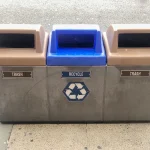
Recycling in high-traffic environments like stadiums, airports, and corporate campuses presents a unique set of challenges compared to residential collection. In these fast-paced settings, users have mere seconds to decide where an item goes. This split-second disposal often leads to massive contamination levels that can render a property’s entire sustainability effort useless.
At Waste Wise Innovation, we focus on the hub. By addressing the specific contaminants found in high-traffic commercial properties, we can secure the integrity of the recycling stream at the source.
The Commercial Contamination Problem
In public venues, the sheer volume of waste and the variety of packaging materials create a perfect storm for recycling failure. Data from 2026 indicates three primary culprits that ruin commercial recycling batches:
- Half-Full Containers: In stadiums and transit hubs, a common contaminant is liquid. A single half-full soda bottle or coffee cup tossed into a recycling bin can soak hundreds of pounds of clean cardboard and paper, making them unfit for processing into new products.
- Flexible Packaging: High-traffic areas are filled with on-the-go snacks. Multi-layer film pouches and plastic wraps are frequently improperly deposited into recycling bins where they eventually jam sorting machinery at recovery facilities.
- Bio-Plastics Confusion: Many modern venues use compostable plastics. Without clear guidance, these are often mixed with traditional PET plastics. This cross-contamination lowers the value of the recycled plastic resin because the two materials cannot be processed together.
The Billion-Dollar Threat: Batteries in Public Bins
While food and liquids ruin materials, batteries represent a physical threat to property infrastructure. In high-traffic zones, the prevalence of small electronics and portable power banks has led to a surge in lithium-ion batteries entering general recycling bins.
The Risk of Inaction: Industry reports show that fire losses in the North American recycling industry reached an estimated $2.5 billion in 2025. Most of these fires were caused by batteries undergoing thermal runaway after being crushed in collection trucks or on-site balers. For a high-traffic property, a fire in a loading dock or waste room is a major safety and operational liability. Up to 40 percent of fires in waste processing facilities are now linked to lithium-ion batteries that were incorrectly disposed of in standard recycling or trash streams.
Redefining the Bin with Material Authentication Units
Standard bins are passive because they rely entirely on the user’s prior knowledge. The Material Authentication Unit transforms the recycling bin into an active participant in the property’s waste management strategy. Designed as a retrofit for existing high-traffic containers, it uses structured behavioral architecture to ensure only the listed items enter the stream.
Precision Through Scanning
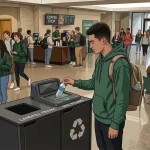
The Material Authentication Unit features an integrated barcode reader. A student at a university or a fan at a stadium simply presents the package barcode to the reader. If the barcode matches the property’s pre-loaded acceptance list, the access door opens. This gatekeeper approach helps eliminate the accidental disposal of batteries, liquids, and unlisted plastics.
Clear Guidance: On-Unit Status Indicators
The interface on each Material Authentication Unit serves as a localized information hub. It does more than just read a code; it functions as clear operational indicators to help users navigate complex waste streams. Because the rules of recycling can change based on the property’s specific waste contract, the color-coded status lights provide instant guidance:
- Code Verification: The status indicators confirm an item barcode is accepted on the local list or indicate that the code is unlisted.
- Stream Guidance: If a user scans an unlisted barcode, such as a specialty battery, glass bottle, or compostable container, the access door remains securely locked. This prompts the user to seek appropriate localized disposal, keeping non-recyclables out of the main container.
- Operational Analytics: For property managers, these connected units act as an Asset Analytics Network. They provide data logs on what material categories are being scanned and identify exactly where volume trends are highest across a campus or venue.
Securing the Future of Commercial Sustainability
High-traffic properties have a responsibility to ensure their sustainability claims match their actual output. By moving away from passive bins and adopting the Material Authentication Unit system, organizations can prevent stream contamination before it starts. We are helping properties turn their waste streams into high-value resources while keeping dangerous materials like batteries where they belong.
At Waste Wise Innovation, we believe that connected data infrastructure leads to a more efficient planet.
Dr. Leotis Bloodworth is the Co-Founder and Chief Executive Officer of Waste Wise Innovation, where he leads the development of advanced technology solutions designed to eliminate recycling stream contamination. A specialist in waste sorting and product development, he is the driving force behind the company’s recycling intelligence network platform. With over a decade of experience in large-scale recycling activations, Dr. Bloodworth has managed post-event waste logistics for major sports stadiums and pioneered initiatives that transform discarded materials into sustainable apparel. Based in Charlotte, North Carolina, he focuses on scaling hardware and software innovations that bridge the gap between physical infrastructure and digital data, empowering organizations to achieve transparent, measurable, and highly efficient circular economy models.