In the world of technology, value is rarely found in a single device. A phone is a tool, but a network of phones is a revolution. This principle, known as Metcalfe’s Law, states that the value of a network is proportional to the square of the number of its connected nodes.
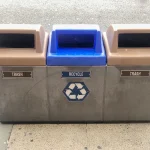
Waste Wise Innovation is applying this law to the physical world of waste management. By deploying Material Authentication Units not as standalone retrofit recycling bin units but as networked sensor nodes, we are creating a data loop that grows more valuable with every single installation.
Beyond the Bin: The Birth of Connected Infrastructure
When one recycling bin fitted with connected technology is placed on a college campus, in a zoo, in a corporate office, or in a stadium, you have a method for collecting data points only for that bin. When a hundred recycling bins fitted with Material Authentication Units are linked across a university campus or a municipal district, you have an integrated data infrastructure.
This network does more than just collect material. It maps the volume, capacity trends, and environmental footprint of an entire facility area over time. Every time a new touchpoint is added to the grid, the resolution of the data increases. Brands and venues stop relying on broad regional estimates and start seeing the true flow of aggregate material collection.
The Power of Cumulative Engagement
The value of the network increases for the consumer just as much as it does for the brand. In an isolated system, an incentive is a one-off event. In a networked system, the act of recycling becomes part of a portable app-based milestone tracking system.
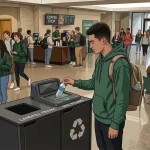
Because the units feed into a unified data network, an opted-in consumer can engage via their mobile app at a stadium on Friday, a retail center on Saturday, and a transit hub on Monday. Each logged interaction builds upon the last within the software ecosystem. The application rewards network captures their commitment to the planet, allowing for:
- Compounding Rewards: Incentives within the separate mobile application that grow as the user hits milestones across different locations.
- Data-Driven Logistics: The system monitors peak disposal volume trends across the entire grid, optimizing janitorial routes based on historical capacity data before a bin overflows.
- Hyper-Local Accuracy: The ability to compare diversion logs between different sectors of a city, allowing for targeted educational campaigns that respond to real-world data.
Closing the Loop with Zero-Party Data
The true programmatic breakthrough happens when the network reaches critical mass. At this stage, the system becomes a highly accurate foundation for verifying aggregate environmental impacts and supporting app-based Zero-Party Data.
Because consumers are performing a physical act that has a positive impact on the planet, they are more willing to volunteer information about their preferences and intent within the mobile rewards app interface. This creates a proprietary community of known advocates. As the network grows, the cost of acquiring this data drops while the quality increases. You are no longer guessing what a consumer might do based on an algorithm; you are viewing what they actually choose to self-report at the most honest touchpoint in the product lifecycle.
Scaling the Impact
A single Material Authentication Unit is a sophisticated piece of hardware. A thousand Material Authentication Units form a connected data-logging infrastructure for the circular economy.
Every new touchpoint added to the network increases the utility of the system. It attracts more brand partners, more consumer participation via app integrations, and more verifiable environmental data. We are not just building bins; we are building the connective tissue for a transparent, sustainable, and highly efficient future.
The more nodes we connect, the clearer the aggregate operational picture becomes, and the faster we close the gap between unmanaged waste and actionable data.
Dan Trujillo is the Chief Brand Officer at Waste Wise Innovation, bringing over 20 years of expertise in brand strategy, UI/UX design, and digital marketing to the forefront of sustainability technology. He specializes in bridging the gap between anonymous recycling bins and measurable marketing assets, leveraging the power of brand storytelling to connect purpose-driven platforms directly with everyday users. By translating complex disposal data into intuitive, human-centered user journeys, Dan helps scale high-engagement recycling intelligence networks that align with global ESG goals while turning sustainable actions into memorable consumer connections.