If you run a high-traffic facility like a stadium, a convention center, or a sprawling campus, you probably have a 2030 sustainability goal taped to your wall. Right now, contamination is the single biggest threat to that goal.
You have likely seen the pitches for automated bins and constant fill alerts. It sounds revolutionary, but to a Facilities Director responsible for thousands of square feet and a crew of 50, complex tech often sounds fragile. It sounds like one more thing that will break during a major event.
Let us be honest. If a sustainability solution complicates your operations or breaks in the field, it is not a solution. It is a liability.
At Waste Wise Innovation, we did not build our technology to satisfy an engineering trend. We built it to solve the real-world operational chaos of high-traffic environments. Here is why your zero-waste plan might be struggling and how we address the skepticism that keeps you awake at night.
Barrier 1: Your Recycling is Technically Trash
Your biggest operational bottleneck is not how quickly your crew empties the bins. It is what users put inside them. When your recycling bin hits 15 percent contamination from half-empty coffee cups or pizza boxes, your hauler may categorize the entire load as trash.
The solution is not another marketing campaign or a new color-coded sticker. It is a Physical Access Control Gate.
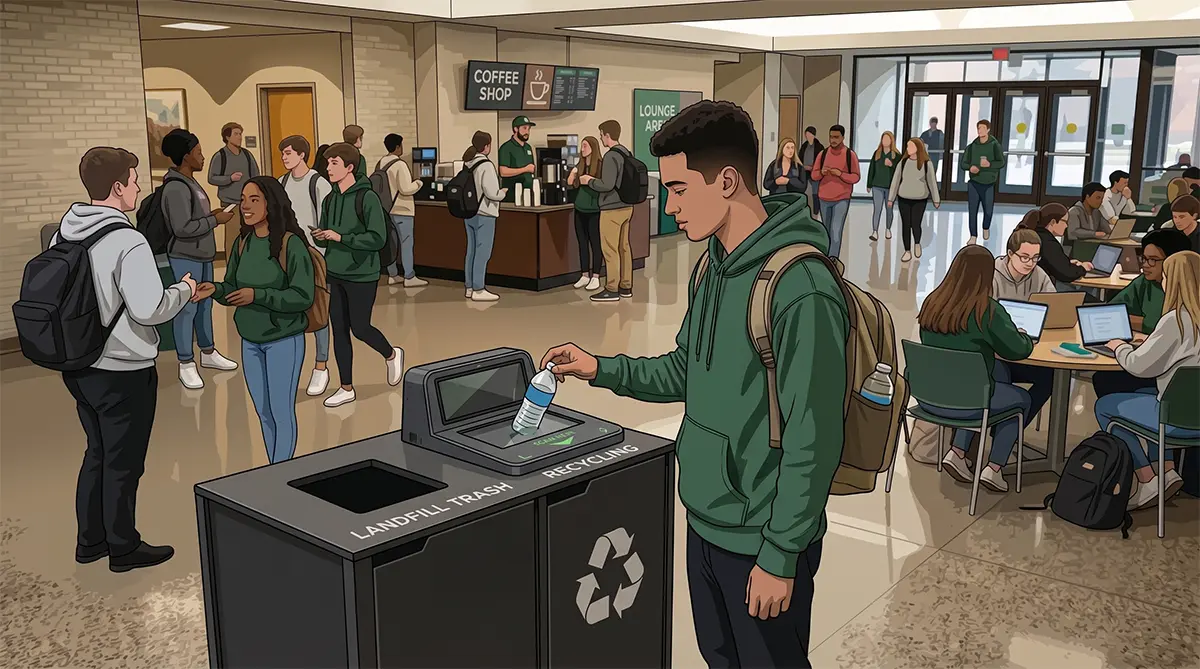
Our Material Authentication Unit utilizes an integrated barcode reader to scan the package label of an item. If the barcode matches an approved code in our pre-loaded list of accepted materials, the access door opens for the container to be deposited. If there is no match or no barcode, the door remains securely locked. This prevents food waste and non-recyclables from ever entering the collection stream.
Barrier 2: Advanced Tech Can Mean Fragile
We know that a bin has two primary jobs. It must hold material and it must not break. The biggest objection we hear is about durability. Clients ask what happens when someone kicks the unit or spills a sugary soda on the component.
Technology that requires white-glove treatment cannot survive a stadium environment. This is why we focus on Hardened Industrial Utility.
Our electronics are weather-sealed. The system is highly durable and designed for high-cycle use in punishing environments. We did not add data connectivity for its own sake. We added it because the problem of stream contamination cannot be solved by a sticker alone.
Barrier 3: Secure Integration Without the Headache
Connectivity is the backbone of data visibility, but it should not be a security risk. Material Authentication Units leverage your facility’s private network infrastructure. By avoiding public networks, we ensure your data logs remain secure and isolated.
While this requires an initial degree of coordination with your IT team to ensure private access, the result is a stable and professional-grade connection. For facilities that require total network independence, we can also build units with a dedicated LTE cellular connection to bypass local infrastructure entirely.
The Barrier We Cannot See: The Burden on Your Crew
We will not save your program if we add even five seconds to your janitorial staff’s workflow. In high-traffic settings, time is the only currency that matters. Our system provides two crucial improvements for the crew:
- Zero Workflow Interruption: The Material Authentication Unit is a non-obtrusive retrofit. It is designed to work with your existing bins in a way that does not interfere with the emptying process. Your crew continues their established maintenance routine without navigating new manual locks.
- Skip Empty Bins: Your crew stops checking empty containers. Aggregate capacity status logs show exactly which containers are approaching their limit. This focuses manpower where it is needed most.
The First Step: A Contamination Audit
Solving zero-waste goals in high-traffic areas is about data visibility and hardened solutions. It is not about complexity. Let us prove it to you. We can identify the specific zones where your program is failing. We can model the cost of those contamination fees and show you how a rugged solution pays for itself.
Ready to get beyond the hype? Let us discuss how to embed quality control into your waste stream.
Dan Trujillo is the Chief Brand Officer at Waste Wise Innovation, bringing over 20 years of expertise in brand strategy, UI/UX design, and digital marketing to the forefront of sustainability technology. He specializes in bridging the gap between anonymous recycling bins and measurable marketing assets, leveraging the power of brand storytelling to connect purpose-driven platforms directly with everyday users. By translating complex disposal data into intuitive, human-centered user journeys, Dan helps scale high-engagement recycling intelligence networks that align with global ESG goals while turning sustainable actions into memorable consumer connections.