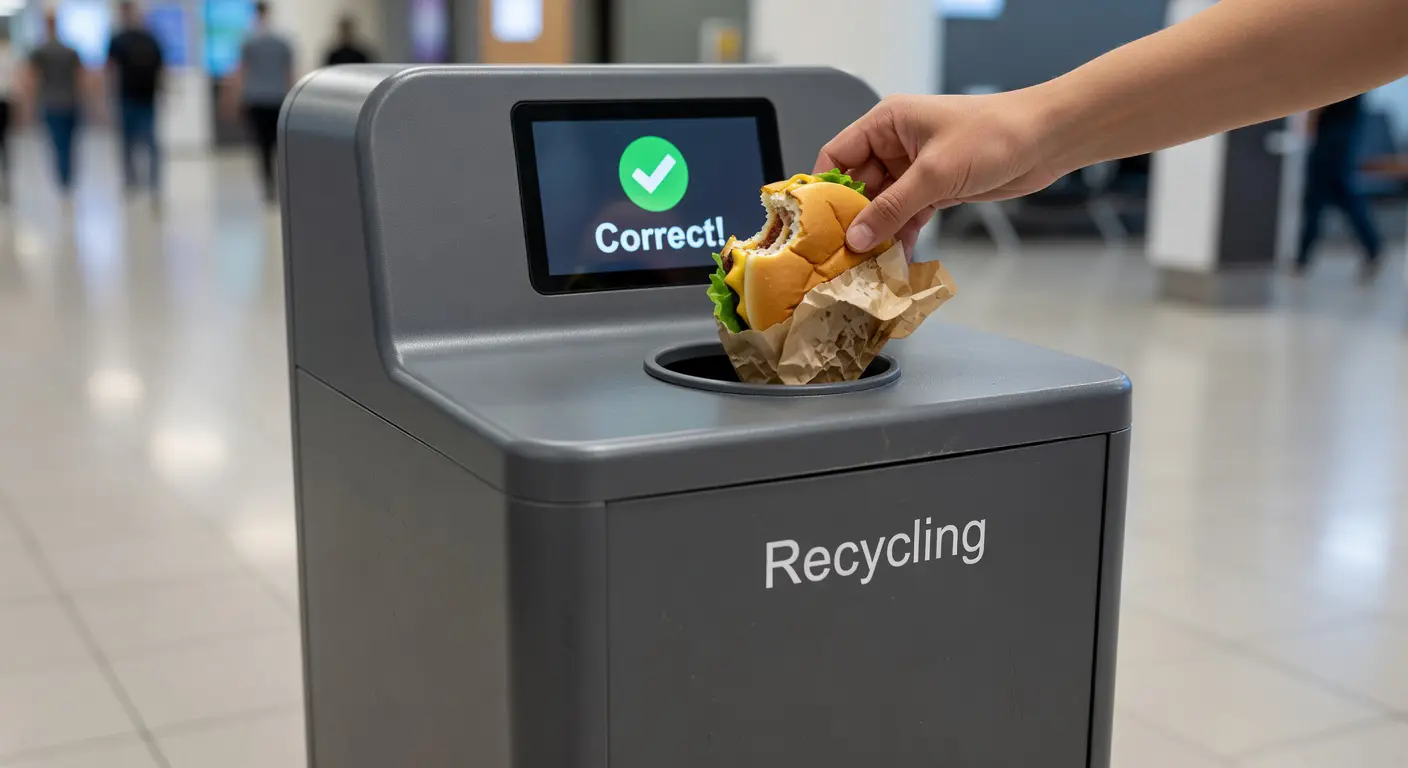
Modern recycling stations are becoming increasingly sophisticated. You can find them in airports, stadiums, corporate campuses, and universities. These stations often feature sleek digital displays designed to show sorting guidance, public announcements, and even animations to engage users. They are excellent for ambient communication and can successfully improve user attention.
However, there is a critical distinction that facility managers must understand. Most display-based systems are designed to influence behavior rather than physically prevent mistakes. In the waste management industry, contamination is an operational failure that organizations often cannot afford.
If a user drops food waste into an open receptacle meant for recycled plastic or aluminum, a nearby screen might have displayed the correct guidance, but the system still allowed the error to occur. This represents the fundamental gap between visual nudging and physical verification. It is the point where many high-tech solutions fail to deliver clean, high-value recycling streams.
The Rise of Connected Recycling and Its Core Dependency
Over the last several years, waste stations have integrated digital displays and detailed dashboards to track regional recycling patterns. This innovation provides valuable data, and in many settings, it helps improve overall environmental awareness.
The challenge is that these visual systems share a common dependency. They only work when people actively freeze, read, and comply with the instructions. In high-traffic environments, users are often rushed, distracted, or carrying multiple items. Public-space recycling cannot be designed for ideal users who have time to study a display. It must be engineered for real-world behavior.
Behavioral Nudging Versus Physical Verification Gates
Screen-based signage is effective at educating, prompting, and measuring community engagement. What it cannot do is stop the wrong item from physically entering the wrong stream.
Physical verification is a completely different approach. It does not rely on a user’s attention span, reading speed, or motivation. Instead, it makes sorting errors materially difficult at the point of disposal by utilizing structured access control.
This is the foundation of the Material Authentication Unit. It is a secure physical interface that relies on a straightforward code scan to verify compatibility before access is granted. A user scans an item’s barcode, matching the code against an on-device acceptance list. If the item matches the local guidelines, the controlled access door opens. If an unverified item is scanned, the sorting gate remains restricted. This is not simply better signage. It is better architecture.
Why Contamination Impacts the Bottom Line
Recycling is a quality-sensitive commodity system. When contamination levels rise, material value drops and manual sorting costs increase. Downstream acceptance by material recovery facilities becomes harder, and collected loads become a high financial liability for the facility.
Many engagement metrics fail to capture a vital reality. A sustainability program can show high user participation rates and still lose money if contamination remains high enough to trigger extra labor charges or hauling rejection fees.
Contamination is not an average metric. It is a strict quality constraint. Once certain thresholds are crossed, the economics of a recycling program can flip from a neutral state to a significant operational cost. The most important question for a facility is not whether people looked at a screen, but whether the physical stream was structurally protected.
The Thirty-Year Bet on Education
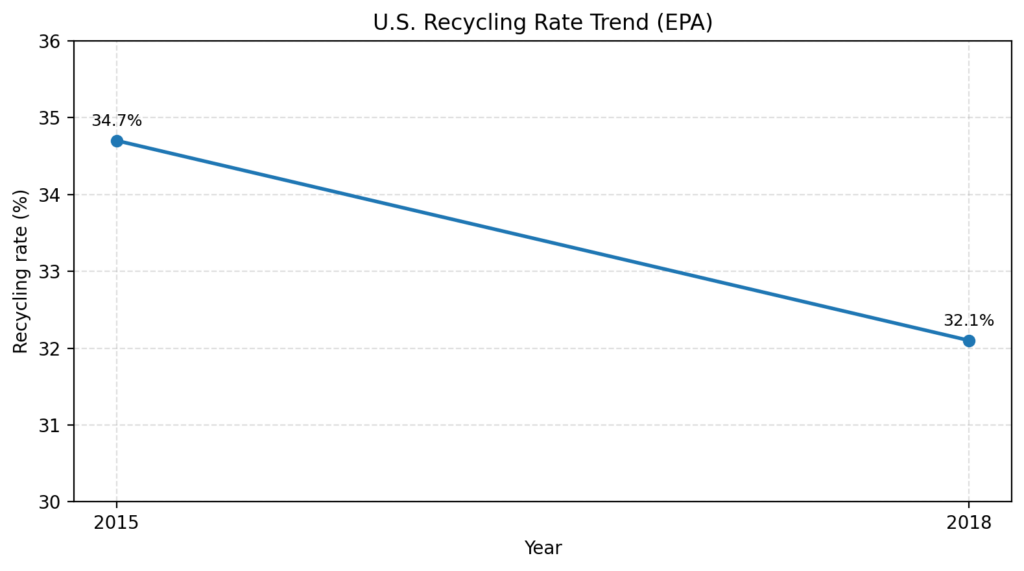
The recycling industry has spent decades attempting to educate its way out of contamination. We have used labels, color-coded bins, and public awareness campaigns. Despite these massive efforts, national sorting performance has plateaued. According to the United States Environmental Protection Agency (EPA), the national recycling and composting rate was 34.7 percent in 2015. By 2018, the rate had declined to 32.1 percent. This trend suggests that purely behavior-based systems have hit a functional ceiling. You can review the national overview here: US EPA — National Overview: Facts and Figures on Materials, Wastes and Recycling.
Education is necessary, but it cannot carry the system alone. This is especially true in public environments where disposal decisions are made in seconds. If contamination remains structurally possible, it will persist regardless of how good the prompts are.
Why Engagement Metrics Do Not Equal Clean Recycling
A screen may increase correct decisions in some cases. However, a facility system must also account for the remaining edge cases. This includes the traveler rushing to a airport gate or the student distracted by a phone. If the station design still allows the wrong item into the opening, the contamination problem is merely reduced rather than solved. In many operational contexts, reduced contamination is still an expensive problem.
Designing Out the Error
The Waste Wise Innovation approach starts with a different question. We do not ask how to convince people to do the right thing. We ask how to design the station so that doing the wrong thing is structurally restricted.
The Material Authentication Unit is built around physical prevention at the point of disposal. This makes the effectiveness of the system independent of user compliance or recycling expertise. This shift is vital because public-space recycling is a flow-of-traffic environment. The system must work even when people are not actively trying to be perfect recyclers.
Prevention, Participation, and Proof
The Waste Wise Innovation platform is designed as a comprehensive, high-integrity stack.
- Prevention through Physical Control: This reduces common cross-stream errors by keeping the disposal path restricted until a barcode matches the local criteria.
- Participation through Incentives: We add behavioral reinforcement through rewards and engagement because voluntary participation still matters for long-term program health.
- Proof through Auditability: The system creates a secure record of anonymous deposit events. This supports stronger reporting and accountability for stakeholders who need defensible data rather than just estimates.
While no digital ledger can validate a physical item on its own, logging anonymous deposit events provides an auditable, verifiable record. This allows stakeholders to trust the recorded data, trace sorting patterns, and reconcile corporate claims with actual collection activity.
The Real Cost of “Good Enough”
If a system merely reduces contamination but still allows it to occur, the organization continues to pay the price. This manifests as lower-value materials, extra custodial labor, and ongoing operational friction.
The real question for any sustainability director or facility manager is how much contamination they are willing to tolerate. If the goal is simply to display general information, screen-first systems are an option. If the goal is to protect material quality at the source and build reporting on defensible data, you need infrastructure that goes beyond recommendations.
From Suggestions to Systems
Ambient digital displays are an impressive communication tool, but they often treat contamination as an education problem. In the real world, contamination is a structural design problem.
The future of clean recycling is not just smarter media prompts. It is smart physical interfaces that reduce error by design. This is especially important where traffic is high and attention spans are low. Recycling is only valuable if it is clean, and it is only credible if the reporting is entirely verifiable.
Ready to Stop Contamination at the Source?
Learn how Waste Wise Innovation’s Material Authentication Units are redefining recycling infrastructure for airports, stadiums, corporate campuses, and municipalities.
Material Authentication Units: Prevention. Participation. Proof.
Waste Wise Innovation: Building the verified recycling infrastructure the circular economy demands.
Dan Trujillo is the Chief Brand Officer at Waste Wise Innovation, bringing over 20 years of expertise in brand strategy, UI/UX design, and digital marketing to the forefront of sustainability technology. He specializes in bridging the gap between anonymous recycling bins and measurable marketing assets, leveraging the power of brand storytelling to connect purpose-driven platforms directly with everyday users. By translating complex disposal data into intuitive, human-centered user journeys, Dan helps scale high-engagement recycling intelligence networks that align with global ESG goals while turning sustainable actions into memorable consumer connections.