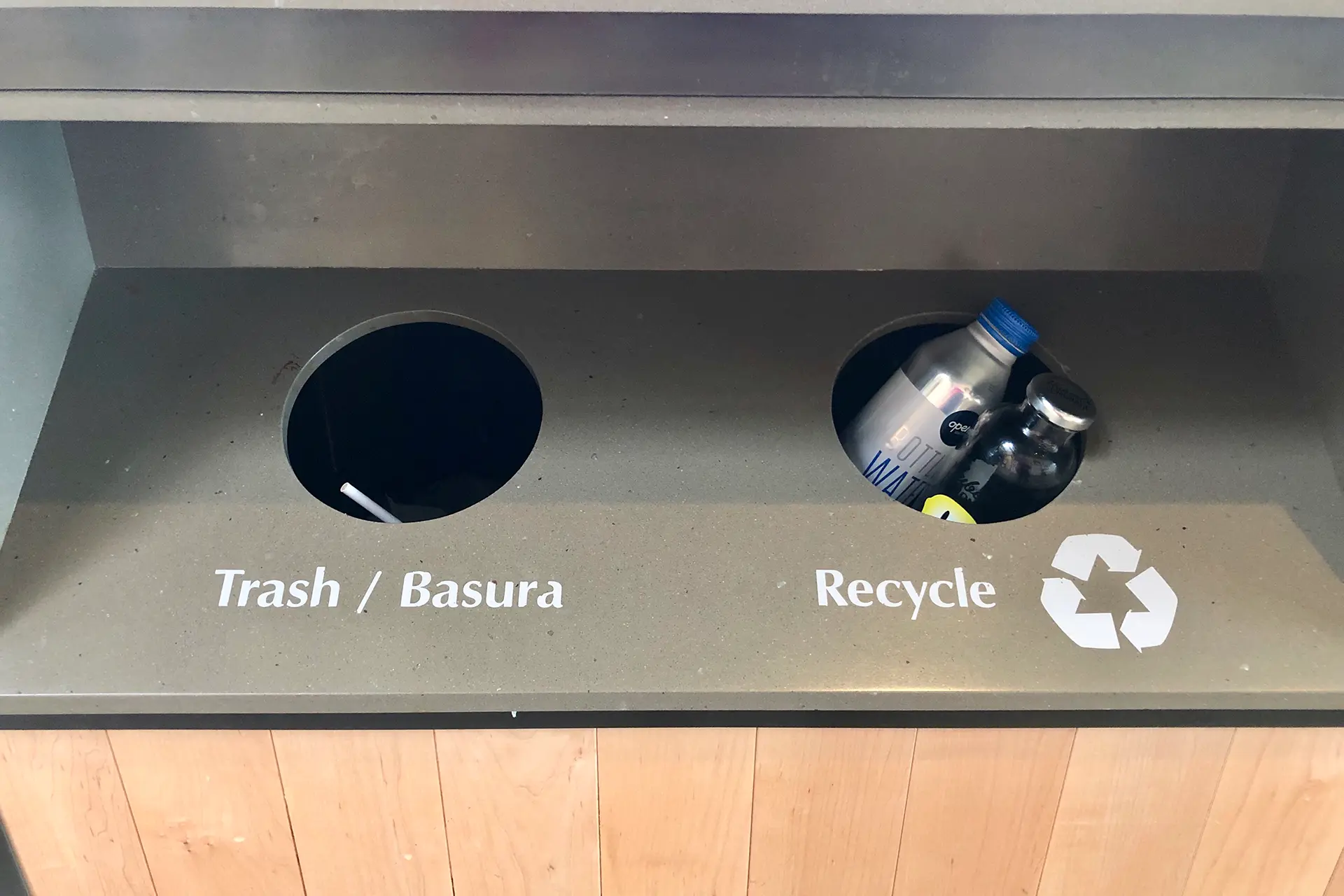
If you ask most people, they will tell you they recycle. They place bottles and cups in the recycling bin and assume those materials are getting a second life.
Reality is more complicated. Across campuses, stadiums, offices, and cities, 30% to 50% of what enters a recycling bin is too contaminated to be recycled at all. Loads are rejected, materials are landfilled, and facilities pay rising fees for recycling that is not really happening.
That gap between intention and outcome is where smarter plastic recycling comes in.
At Waste Wise Innovation, we define smarter plastic recycling as a system that uses technology, data, and design to ensure that plastic bottles, cups, and cans are:
- Collected cleanly
- Measured accurately
- Managed and reported transparently
This is not about a new logo on a bin or one more awareness campaign. It is about making recycling work the way people already think it does.
What Is Broken in Traditional Plastic Recycling
Most recycling programs rely on three tools:
- Static signage (“Cans and Bottles Only”)
- Periodic education campaigns (emails, posters, training)
- Back-end sorting and hauling
These tools struggle with three stubborn problems:
- Contamination at the bin: Non-recyclables and dirty items enter the stream unchecked. A few wrong items can cause an entire bag, or even a truckload, to be rejected at the material recovery facility (MRF).
- No visibility into what is really happening: Many organizations do not know which bins or buildings are most contaminated, what items are causing problems, or whether education efforts are working.
- No feedback loop for behavior change: Users rarely get instant feedback. They drop an item, walk away, and never know whether they got it right.
The result is good intentions without good outcomes, leading to a lot of wasted time and money.
What “Smarter” Plastic Recycling Actually Means
Smarter plastic recycling does not mean more complicated processes. It means smarter, connected systems that work in the background to prevent problems before they start.
A smarter system has four key characteristics:
- Prevents contamination at the source: The bin does not just accept whatever is thrown at it. It uses barcode scanning matched against an on-device acceptance list to determine whether an item’s code is approved before it enters the bin, stopping contamination early instead of trying to fix it later.
- Captures detailed data: Each accepted deposit is logged as an anonymous, timestamped event. You know what is being recycled, when, and where, with the ability to zoom in from campus-level trends to individual bin performance.
- Shapes on-the-spot behavior: The system responds to each user and each item through physical, color-coded status lights. When an item is scanned, the status lights communicate the result on the spot to guide user behavior.
- Connects operations, reporting, and impact: Analytics for logged deposits feed directly into hauling decisions, ESG and sustainability reports, LEED certification documentation, and long-term infrastructure strategy.
In other words, smarter plastic recycling turns recycling from a black box into a transparent, optimizable system.
How Waste Wise Innovation Enables Smarter Plastic Recycling
Waste Wise Innovation was built to solve these problems at the source. Our solutions combine connected hardware with powerful analytics to clean up recycling streams and unlock real, measurable impact.
Material Authentication Unit: Intelligence at the Bin
Our flagship solution, the Material Authentication Unit, is a smart lid system that sits on top of recycling bins and verifies each item’s code before it is accepted.
Here is how it works:
- Scan: A user presents the item’s barcode. The on-device scanner reads the code, ensuring no image of the item is captured or classified.
- Decide: The unit matches the scanned code against a local, on-device acceptance list configured for your property. The decision runs locally and works even without a network connection.
- Educate: If the item is accepted, the access door opens for deposit. Color-coded status lights (amber for checking, green for accepted, and red for not accepted) communicate the result on the spot, while static on-unit signage explains what the lights mean.
- Log: Each accepted deposit is logged as an anonymous event, meaning no personal data is ever stored at the bin.
- Reward: Users who opt in earn digital points in the rewards app, which are credited server-side to their own account. No reward is dispensed at the bin itself.
The result is cleaner plastic streams from day one. Instead of sorting or rejecting contaminated bags later, you drastically reduce contamination before it ever enters the bin.
The Material Authentication Unit is already being deployed in real-world environments like university campuses and major venues. For example, at the University of South Carolina Upstate, early pilots show cleaner recycling streams and alignment between recyclable materials and barcode data, supporting more effective recycling across campus. You can read more in our recent USC Upstate pilot recap.
Infrastructure Analytics: Turning Every Deposit into Data
Smarter recycling requires smarter data. Infrastructure Analytics captures and organizes the information generated by every interaction with the Material Authentication Unit.
With Infrastructure Analytics, you can:
- Track volume and weight of plastics and other recyclables by building, floor, department, or individual bin.
- Identify contamination hotspots and underperforming locations in real time.
- Compare performance across residence halls, academic buildings, general stadium seating, premium suites, or different corporate campuses.
This level of insight lets you target education where it is truly needed, validate the impact of new policies, negotiate smarter hauling contracts based on actual performance, and feed auditable analytics for logged deposits into ESG reports and LEED submissions. Infrastructure Analytics transforms recycling from guesswork into data-driven resource management.
Recycle Smart Monitoring System™ (RSMS): Smarter Collection and Operations
Even the cleanest recycling stream can fail if bins overflow or are serviced inefficiently. Our Recycle Smart Monitoring System™ (RSMS), available with the Material Authentication Unit, measures bin fullness over time.
RSMS learns the depth of each bin when empty, checks bin depth at specified intervals, and sends email or text notifications as bins reach threshold fullness. This helps prevent overflow, optimize collection routes, and reduce unnecessary pickups and related emissions.
EcoLedger™, Chain of Custody & Supply Chain Tools
Beyond collection, smarter plastic recycling requires traceability and accountability. Tools like EcoLedger™, Chain of Custody, and our sustainable supply chain solutions help organizations document material flows from collection to processing, support claims about diversion rates, and align procurement with circularity goals.
When combined with the Material Authentication Unit and Infrastructure Analytics, these tools create an end-to-end framework for verifiable, smarter plastic recycling.
Who Benefits from Smarter Plastic Recycling?
Smarter systems deliver value across sectors:
- Universities & Colleges: Clean up plastics across residence halls, dining, and event spaces while providing sustainability teams with reliable data for grants, rankings, and ESG reporting.
- Sports & Entertainment Venues: Keep contamination low during peak events and show fans visible, interactive sustainability in action.
- Corporate Campuses & Office Buildings: Standardize recycling performance across multiple locations and supply facilities and ESG teams with measurable proof of impact.
- Municipalities & Smart Cities: Improve recycling quality at public bins and transit hubs while using granular data to guide contracts and public outreach.
In each case, smarter plastic recycling means the same thing: less contamination, more usable material, better data, and clearer proof of results.
Why Now Is the Time to Get Smarter
Regulations, ESG expectations, and stakeholder scrutiny are all moving in the same direction:
- More pressure to prove diversion and recycled content, not just claim it.
- Growing emphasis on quality and contamination rates, not just tonnage collected.
- Rising costs for rejected loads and contamination fees.
At the same time, people still care deeply about recycling. The problem is not a lack of good intentions; it is a lack of systems that support those intentions at the point of action. That is exactly what smarter plastic recycling, and Waste Wise Innovation, are designed to deliver.
Build Your Smarter Plastic Recycling Strategy
Whether you manage a single facility or a global portfolio, the path forward starts at the bin:
- Prevent contamination at the source with the Material Authentication Unit.
- Capture analytics for logged deposits with Infrastructure Analytics.
- Optimize operations using the Recycle Smart Monitoring System™ and related tools.
- Document and communicate impact through EcoLedger™, chain of custody, and supply chain solutions.
If you are ready to move from wishful thinking to measurable, smarter plastic recycling, we would love to talk.
You can book a meeting or reach us directly at +1 (704) 464-2179 to turn every plastic bottle and cup that enters your facility into a clean, verifiable resource.
Dan Trujillo is the Chief Brand Officer at Waste Wise Innovation, bringing over 20 years of expertise in brand strategy, UI/UX design, and digital marketing to the forefront of sustainability technology. He specializes in bridging the gap between anonymous recycling bins and measurable marketing assets, leveraging the power of brand storytelling to connect purpose-driven platforms directly with everyday users. By translating complex disposal data into intuitive, human-centered user journeys, Dan helps scale high-engagement recycling intelligence networks that align with global ESG goals while turning sustainable actions into memorable consumer connections.